For those of us who have indulged in higher education, we have probably spent more time dwelling on the meaning of words than is ordinarily so. Academia is often a game of (relative) triviality and minutiae, with careers made by branding a particular take on identity or subjectivity or whatever else.
A word that I find particularly interesting is “idiot.” In the UK “idiot” is often thrown about as a casual pejorative. In some cases it even harbours shades of endearment, like when friends or partners call each other idiots for doing something daft. I’m sure I have been called one on countless occasions and have smiled, laughed and agreed. In such instances “idiot” is deployed as a synonym for “stupid” as in, “you idiot/stupid person, I can’t believe you put your car keys in the washing machine!” Thus “idiot” isn’t at the sharp end of the insult spectrum, although its cutting effects are of course contextually determined.
It’s interesting to consider the origin of the term “idiot” though because it has special relevance for modern times, by which I mean the last forty years (especially the last ten). “Idiot” derives from the Greek term idiōtēs, a literal translation of which is “private person.” This doesn’t mean introvert though its meaning is far more specific, in that private person means “a person who does not take part in the affairs of the polis.” Put another way it means ignorant of politics and/or does not participate in public affairs. “Private person” therefore serves as a contrast with outward looking people whose actions exhibit awareness of broader realities housed within power relations.
One thing we can safely conclude from the last decade is that the population comprises idiots (in the original Greek sense) to a large extent. These idiots may well be educated (which doesn’t necessarily mean you are politically aware), and may well have specialist knowledge that helps them enjoy some modicum of success as economic actors. And yet, when it comes to politics they don’t know and don’t want to know. In fact it is worse than that, if these people knew nothing at all they would be in a better position to contribute to the polis than they are presently. Frustratingly, the limited political awareness of your average idiot comes from parents (who themselves were ignorant in many cases), friends (who usually share their own biases and prejudices) and self-referential fragments of half-remembered media output. As Thomas Jefferson wryly observed “someone who doesn’t read is better educated than someone who reads a newspaper.” To some extent schools and other institutions have a bearing too, although it’s hard to isolate the extent of these amidst aforementioned socialisation processes.
Why people are or become idiots is an interesting question, one which I’m happy to sidestep here. Much greater minds than mine have sought to understand how and why people act against their own interests and have failed to completely satisfy themselves (Eric Hobsbawn being the most prominent example).
All I know is that the Conservative party electoral majority of 2015, the Brexit referendum “win” and the election of “The Donald” in 2016, and then the Tory landslide of 2019 made it irrefutable that a large proportion of UK/US voters are idiots. For “rust belt” voters to opt for Trump and “Brexit/red wall” voters to opt for “leave” then Johnson is stunningly idiotic. Non-idiots relatedly went through all the stages of grief because of these self-inflicted blows to the interests of the plebeian class. Watching the chickens put the fox in charge of the hen house gives civilised people no pleasure. I’m angry at Trump/Brexit voters but to a greater extent I feel sorry for them. The Covid-19 pandemic has exposed the tip of the effects iceberg as Trump shrugs off 200,000 U.S. citizens dead as “nothing.”
Many of us academic non-idiots (by which I mean politically engaged and active – able and willing to fight in service of our shared interests) fantasise about freeing the world from idiots. We dream of a day when people are equipped with the requisite tools to smell bulls#*t, to critique and reject “post-truth” and to firmly reject divide-and-rule power plays. We hope to do our small bit, to awaken one mind at a time if need be and to leave the world a little less idiotic than we found it. We cannot do this by ourselves of course, we are but bit part actors on a globalised stage largely out of our control. Our solace is that to do something is better than to do nothing, however small it may be.
Yet let’s not kid ourselves the game is rigged against us to an overwhelming extent. Once money and power have become highly concentrated beneficiaries will use it to accumulate ever more of both. The existence of power implies powerlessness: more of the former synchronously delivers more of the latter.
So what do you do when you are born into a world of extreme inequality, a growing divide between the rich/powerful and everyone else and an electorate of idiots who enable the “elite” to profit from “disaster capitalism?” This latter term refers to a system whereby kleptrocrats purposefully destroy and damage in the belief that they will profit personally, irrespective of the wider costs. To be clear ignorance, arrogance and incompetence also contribute to the nature of managerialism in Western nations but the current governing principle is to profit from failure and/or disaster rather than prevent it. As Trump’s recently published tax records show he makes money despite losing fortunes and perhaps because of it. Similarly, Jacob Rees Mogg’s hedge fund has been betting against the UK economy ever since the Brexit referendum. What makes this remarkable is the he’s the symbolic figurehead of the ERG, the Tory’s anti-EU extremist wing. In essence he’s pushed for a hard Brexit as an MP whilst betting it will damage the UK economy for personal and co-elite profit! To say these people have no shame is an understatement.
So what do you do? In the UK these sociopaths have at least four more years in office. Hard Brexit seems highly likely and so does a Trump rejection of a Biden win, precipitating a constitutional crisis in the US. In my view you can only do three things: (1) be a good citizen, trying (in whatever limited capacity) to lead by example; (2) persuade those who are persuadable. Sadly, minds appear to have closed and congealed at polarised ends of the spectrum. And yet, there are some who are humble enough to remain open to the possibility of being wrong. I say this as a former Tory party member who crossed over as a consequence of education, thereby proving that convictions can be displaced. (3) You prepare for the worst even whilst hoping for the best as a private person. None of us are islands but I have sadly come to the conclusions that you have to proactively protect yourself from sociopaths and idiots alike.
When Boris Johnson won a landslide election in 2019 this made Brexit inevitable and “hard/no deal Brexit” probable. In my mind it also made chaos and incompetence a near certainty. Just take a look at Johnson’s cabinet, selected largely on the basis of Brexit fervour rather than competence or credibility. If there is a deal it seems likely to be a last minute fudge after supply line have been disrupted, and after we have insulted and pissed off the whole of Europe (which has considerable power to spite us) to an even greater extent.
My lack of faith in this government led me to begin stockpiling essential goods in December 2019, four months before the general population imitated during the Covid-19 lockdown. Obviously I had no more foresight of the global pandemic than anybody else when I began stockpiling; I wasn’t doing it with a public health crisis in mind but rather a political one. I didn’t feel smug or proven right when supermarket shelves were empty in March. I just felt lucky that a decision taken in light of predictable crisis A had considerable knock-on benefits for unpredicted crisis B.
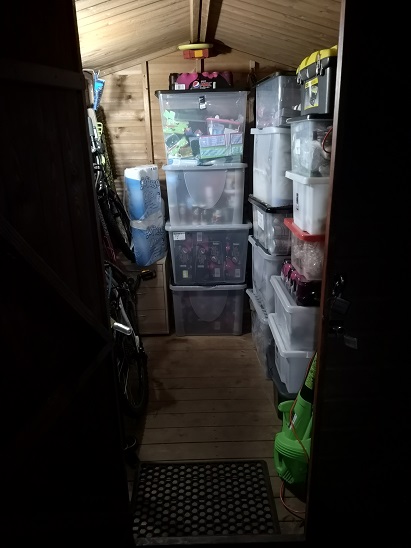
Once the shelves had been refilled by mid-summer I resumed the slow process of gathering supplies. It has been a matter of a few bits a week, spending roughly £50 per month and for the most part buying non-perishable food goods. Rather than buy just-in-time from the supermarkets I have therefore built a buffer stock. Now the system is in place I have reverted to shopping exactly as everybody else does – albeit, with a 6-12 month reserve in case the worst happens. If it doesn’t (and obviously I don’t want it to) then I have lost nothing because I will eventually use my buffer stock anyway. The only cost is space and a small amount of money tied up in stored provisions.
Back during the panic buying period many people commented on the selfishness of stock piling and I agreed with them, although I didn’t blame individuals. Instead I blamed supermarkets and state actors who could have done much more to stave off panic. As it proved many of us did not trust authorities to look after us and thought “well we’re going to have to look after ourselves!” Resultantly we saw some “civilised” people acting like animals as civility broke down as quickly as “preppers” predicted that it would in such circumstances. I didn’t panic buy in March in part because I didn’t have to. I only began stockpiling again once shelves were full a few months later as mentioned above.
Since goods supply has expanded throughout summer everybody has had a fair chance to buy a little extra in preparation for the “second wave” and a likely “no deal.” As a consequence I will feel no shame or guilt if the worst happens and people cannot get essential provisions this winter. I know that millions of people do not have the storage space or money to spare and that is an awful situation. Let us not forget though that past or present political decisions (under the auspices of Thatcherism/Reaganism) have directly led to these forms of poverty.
There are however many millions who do have the money and storage space but remain happy to entrust supply security to others. In the current context that strikes me as borderline insane but it’s taken as “normal,” in part because for a long time it has been. I would imagine that some who read this will take it as “alarmist fearmongering” but I wonder if having a few hundred pounds worth of food and medical supplies just in case is so radical? Personally, I think it’s radical for people to have £40k of stored wealth invested in their car but little or nothing invested in survival essentials. Maybe my priorities are upside down but there’s a strong argument to say the opposite is true.
So what’s my point here? Well, whilst I will continue to do my bit to prevent the worst from happening it seems increasingly likely to happen anyway. As said, to a large extent the UK & US’ economies are now based upon the management class profiting from the chaos that they themselves cause, meaning that their interests are diametrically opposed to ours. Given that power breeds power it is incredibly difficult for outsiders to halt or slow these processes. The only real power of the powerless is to impose a united front, which is exactly the reason those in power seek to divide us. In this they have been incredibly successful with the “culture war” increasingly prescient in everyday life.
It would be foolish to ignore the knowledge you have as a non-idiot when it comes to managing your life as a private person (going back to the above definition of “idiot”). I hope to be politically engaged for the rest of my life and yet as a private person I have a duty of self-preservation. Even if the best case scenario plays out in relation to Brexit and Covid-19 going forward, it seems reasonable to believe that still worse crises are just round the corner – especially relating to climate change.
I hope for the best of all worlds for the greatest number of people but I make no apologies for preparing for the opposite case. At this point it seems foolish to do otherwise and I would advise others to do the same. Use the system and contribute to the system but don’t rely on it to keep you safe in a crisis. As Bhaskar notes crises reveal the nature of power and in my view it has revealed its dark contemporary heart. 2020 has shown us how the system will fail you when push comes to shove – a timely reminder of the cost of complacency. To forget inherent lessons after only a few months is the very definition of idiocy.
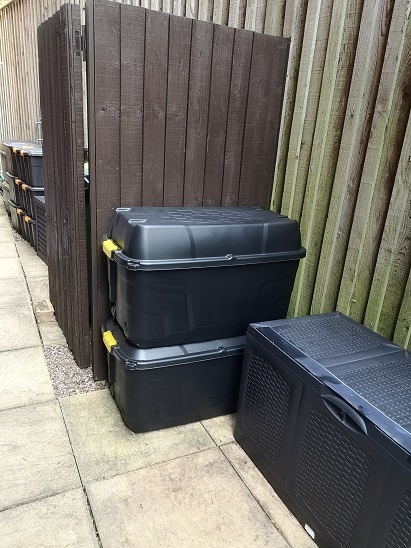
I have added a few pics merely to highlight how I practice what I preach. Right-wing politicians love to talk about “individual responsibility” and that’s exactly what I have taken. It’s a shame they haven’t done the same during the crises discussed above.
 Dr Martin James